
Irrational Affects and Political Representation in the Global South
DOI:
https://doi.org/10.46502/issn.2792-3681/2026.10.0Keywords:
political irrationality, post-truth, political subjectivity, political communication in the twenty-first century.Abstract
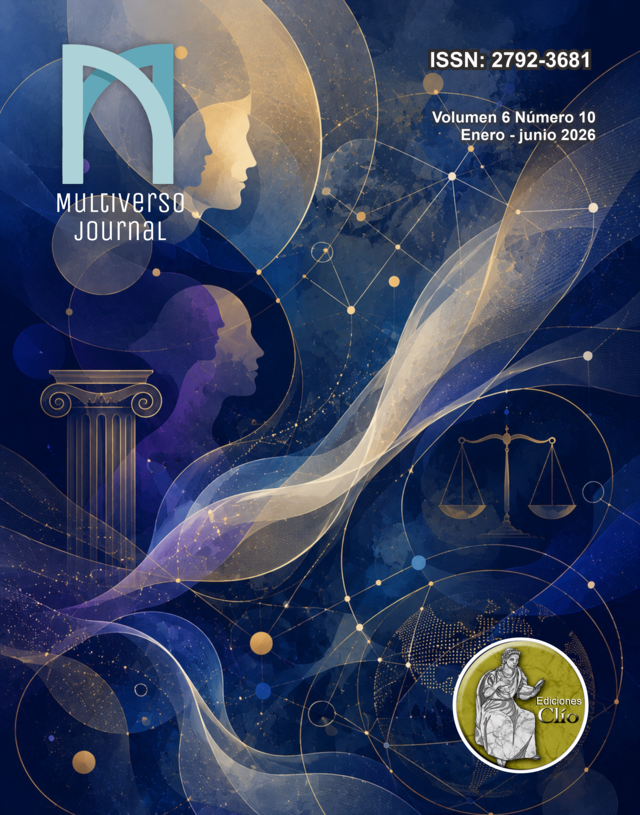
This text serves as the editorial for Volume 6, Issue 10 of Multiverso Journal, corresponding to the January–June 2026 edition. Its purpose is to introduce the central reflections guiding this issue, highlighting the need to critically examine the political, social, and communicational phenomena that shape contemporary reality. In particular, it invites readers to explore the role of social media, collective affects, and discursive strategies in the formation of public opinion, as well as their implications for democracy, citizen participation, and the persistence of structural inequalities. From an interdisciplinary perspective, the editorial proposes understanding current challenges not only as technical or informational problems, but also as ethical, cultural, and political issues. In this way, the volume brings together contributions aimed at promoting critical thinking, academic debate, and the search for alternatives capable of responding to the complexities of the contemporary world.
References
Martel, C., Pennycook, G., & Rand, D. G. (2020). Reliance on emotion promotes belief in fake news. Cognitive Research: Principles and Implications, 5, 47. https://doi.org/10.1186/s41235-020-00252-3
Schöne, J. P., Parkinson, B., & Goldenberg, A. (2021). Negativity spreads more than positivity on Twitter after both positive and negative political situations. Affective Science, 2(4), 379–390. https://doi.org/10.1007/s42761-021-00057-7
Vasist, P. N., Chatterjee, D., & Krishnan, S. (2023). The polarizing impact of political disinformation and hate speech: A cross-country configural narrative. Information Systems Frontiers, 25, 1957–1977. https://doi.org/10.1007/s10796-023-10390-w

Published
How to Cite
Issue
Section
License
Copyright (c) 2026 Jorge Jesús Villasmil Espinoza, Diego Felipe Arbeláez Campillo

This work is licensed under a Creative Commons Attribution 4.0 International License.
The authors who publish in this journal agree to the following terms:
The authors retain copyright and guarantee the journal the right to be the first publication where the article is presented, which is published under a Creative Commons Attribution License, which allows others to share the work prior to acknowledgment of the authorship of the article. work and initial publication in this journal.
Authors may separately enter into additional agreements for non-exclusive distribution of the version of the work published in the journal (for example, placing it in an institutional repository or publishing it in a book), with an acknowledgment of its initial publication in this journal.